13 November 2021

Open Letter to Steve Martin and Edie Brickell

Mr. Martin and Ms. Brickell,

For the past several weeks I have had the pleasure of attempting to decipher Daddy Murphy for Elkhart Civic Theatre's production of Bright Star. Our production process has been fraught with unexpected difficulties, yet also a delight due in no small part to the way your script draws people into a story that matters.

Thank you for writing a musical with complicated characters who entrench and resist and regret and change and adapt, sometimes all at once. Thank you for writing a sweeping tale of pain and redemption (ahem) that never veers so far toward either that it becomes easy to watch or perform—a story that remains ambiguous and challenging throughout. Thank you for a story that prompts performers to leave the stage sometimes weeping openly at the sheer beauty and kindness and smallness and ridiculousness of humanity.

Thank you.

Brent Graber


PS: We opened our two weekend run on November 12, 2021. Tickets are still available for our performances on November 13, 14, 19, 20, and 21. You know, in case you want to remind yourselves how good you are.

30 November 2016

Google Apps and PHP

Because I find Google Apps Admin SDK Directory API PHP Quickstart to be a bit ... spare, and because I spent far too much time searching to find proper examples, here's one more place for poor saps like myself to maybe find some of what they need.

First, the PHP Quickstart, linked above. That should at least get a person connected.

Second, this lovely bit from Michael Seiler. The details (as of November 2016) are no longer quite the same (e.g., the line numbers he refers to in the code are no longer correct), but on the whole this worked.

Third, this thing that a suitably-energized person can probably figure out. (I was able to see, at least somewhat, what Michael Seiler was referring to by using this. That was not the case from looking at the code I'd downloaded from the Quickstart.)

30 June 2016

Yes

http://www.computerwizardindy.com/my-fix-for-windows-update-error-80070011/

(Edit: Nov 30, 2016 -- seems like that site no longer exists. May need to rely on Wayback or search engine cache.)

04 October 2013

Two posts in a day!

A year of nothing, and now two posts in a day.

How to write to an NTFS drive on Mac OS X 10.8.4 (specifically, how to replace a troublesome ntdll.dll file on Windows 7 running in Bootcamp):

  1. Boot into the Mac OS.
  2. Start a terminal session.
  3. diskutil info /Volumes/BOOTCAMP | grep UUID
  4. Copy the UUID
  5. Use your favorite text editor (why would it be anything other than vi?) and sudo /etc/fstab
  6. Type: UUID=<UUID you copied> none ntfs,rw,auto nobrowse all on one line. The nobrowse is critical for this to work.
  7. Save the file
  8. Open the disk utility, find the BOOTCAMP volume and unmount it.
  9. Remount the BOOTCAMP volume.
  10. In the terminal window type open /Volumes/BOOTCAMP to open the windows partition in the Finder.
  11. Modify as needed. (This, at least, worked just fine for me to replace a balky ntdll.dll file that was crashing whenever I'd be organizing files in Windows Explorer.)

One Year

The last time I posted to this blog was one year ago today.

Ping.

04 October 2012

HP 2035, HP 1020, Windows 7 64-bit, printing problem

For future reference, this is how I got a balky HP 2035 to (finally) print from Windows 64-bit, both by USB connection on a local machine and through a network connection. Frankly, it shouldn't be so hard.
  1. Spend a lot of time researching. Find a lot of people saying things like "C'mon, Microsoft or HP or Adobe, fix this problem." (One common problem has to do with printing a particular sort of Adobe file on an HP 1020 in Windows 7 64-bit. That was not precisely the problem I was having.)
  2. Delete every HP printer from the system.
  3. Restart the print spooler.
  4. Go into the Print Server properties and delete every HP driver in its entirety.
  5. In the registry, go to HKLM/Software/Microsoft/Windows NT/CurrentVersion/Print/Printers. Delete every HP entry you can find.
  6. Go to C:\Windows\System32\DriverStore\FileRepository.
  7. Take ownership of the suspected troubling HP folders (in the case of the 1020 and the 2035 these were obvious). Give yourself full permissions, apply those to child objects, and don't allow inheritance.
  8. Delete those folders.
  9. Disconnect the printer and use the HP driver. I had to use the one on the CD; the latest download failed utterly. Follow the instructions in the driver install (this seems to matter).
  10. Install the other printers.

Repeat this on any other computer with which you want to use that printer over the network.

To be clear, this is what I did specifically for an HP 2035, in part because I got the 2035 hoping it would work more easily with Windows 7 64-bit than did the gob of HP 1020s we have where I work. I was greatly dismayed when I had exactly the same problem. I now suspect that had I gone through these steps for the 1020 it would also have worked.

12 July 2012

Of Tools and Grace


This is an article I wrote that appeared in Conspire (Spring 2012).

As the sole technology worker at a seminary, I am responsible for researching, recommending, implementing, and supporting technological answers to institutional questions. Since a primary task of the seminary is to educate students, part of my job is to pay attention to developments in the field of educational technology.

One way I do this is by attending conferences. At every educational technology conference I’ve attended, someone will say “But it [education] is not about the technology.”

This mantra is a good and healthy reminder. It also reveals something of the easy way that we (technology-workers specifically, but also people in general) can deceive ourselves. The statement is usually made as a corrective, long after it has become abundantly clear to the interlocutors that “it” is, in fact, precisely about the technology. In “Educational Technology,” technology is the noun, yet we persist in claiming otherwise. Why?

I think part of the denial is because most people think of technology as something neutral that can be used for good or ill. If this is true, then we are free to use it as we see fit. We are free to talk about technology and propose technological solutions to, say, pedagogical problems, secure in the knowledge that we’re only using the tools available to us to accomplish some greater end.

Part of our denial is because we have come to accept that most questions and dilemmas can be answered with a tool. This belief not only changes the nature of the solution, but it actually alters the problem as well. We stop asking: “How can we do this?” or even “Should we do this?”and start asking: “How can we use said tool to do this?” By answering that last, easier, question, we assume that we have answered the first two as well.

This shift has troubling implications for any community, including the seminary community of which I am a part. Consider a few examples.

When I want to contact someone at work, my first inclination is to send an email message, not to walk down the hall. Pre-email, I would probably have called. I know, rationally, that the instantaneity offered by technology is not the same as the intimacy of the office visit, but, practically, I’ve come to equate the two--or at least to settle for the instantaneous. Instantaneity can be realized with a tool (email); intimacy cannot.

When I hear about neighbors who are in need, my first inclination (after I wring my hands feeling generally powerless) is to provide some sort of financial support. I know, rationally, that alleviating a financial burden is not the same as true support, but, practically, I’ve come to equate the two--or at least to settle for the financial unburdening. Unburdening can be realized with a tool (money); supporting one another in love cannot.

When my congregation discusses how to be more hospitable and welcoming, one recurring suggestion is for everyone to wear name tags. We equate knowing each others names to knowing one another better. Rationally, I know that collegiality is not the full extent of fellowship, but, practically, I’ve come to equate the two--or at least to settle for the collegial. Collegiality can be approximated with a tool (name tag); fellowship cannot.

The problem in these examples is not instantaneity, financial aid, or collegiality, which may not be bad things within themselves. The problem is when we come to see them as tantamount to something greater: fellowship, support, or intimacy. Technology, often seen as a neutral tool, leads us to make this false equivalence.

So as the director of information technology at a seminary (which I take to mean a community marked by traits like fellowship, support, and intimacy, among others), my job is to recommend, implement, and support those very things that over time work against becoming that sort of community. So I take it as my responsibility, though it isn’t written into my job description, to ask questions like: Do we need technology to accomplish this particular task? Do we need this particular piece of technology? What does it cost to use (not just a financial consideration)? What will it cost to stop using it?

Except that most days, I don’t actively ask myself those questions. I stuff them in the background, or hang them on the wall of my peripheral vision. Then I create processes and procedures that let me purchase, upgrade, and install without needing to ask questions about any particular technology. Because the “technology” of processes and policies answers these questions—the questions that seek a technological answer--I never need to ask the bigger, more demanding, questions. 

I justify this by telling myself that there are some things that institutions require; and that the nature of my job is such that I do not have the luxury of actively wrestling with the bigger questions. After all, my job is about helping the seminary fulfill its mission. It’s the seminary’s mission which is about the reign of God, so I am therefore freed to deal exclusively with technology-as-tool.

And so we come full circle, and I fall into the same behaviors that so frustrate me at educational technology conferences or nametag discussions or office communications across the hall. I, too, find myself using technological tools to address the questions that technology poses, and, in so doing, rest in my own little deception.

Yet grace abounds.

Grace abounds when I get interrupted in some way that wrenches me out of my technological patterns. When a co-worker stops by my office, that more intimate visit makes demands of me that the instantaneity of email does not. When my neighbor suggests that I can help her by babysitting her children so she can have some time alone; that demands of me things that donating to the local food bank does not. When a visitor to my church starts to spill his life story in my lap, that fellowship requires what simply “knowing” his name does not.

Sometimes this grace makes me bold. In such moments, I seek technology that is good enough to do what needs to be done most of the time, but not so capable that it leaves no room for our human messiness—failure, interruption, and intimacy. And on especially rare days, I suggest to others at the seminary that problems with our email provider give us a chance to reflect on how reliant we’ve become on email, what that might say about us, and whether it’s good.

Those moments are relatively few and far between, though, so if you visit me at work you will be hard-pressed to find how the nice story I’ve written above plays out concretely. This is because, more honestly, most of the time I wish grace wouldn’t abound quite so much.

29 March 2012

Toot toot

There's this:


And this:


And from a critic, this:
There is a moment in the spotlight for each character and they make the most of it, with special applause to Butler for inhabiting the show’s best known speller and making it his own,, and to Riggs, for finding just the right blend of comedy and tragedy and delivering it all in a clear, never-miss soprano. Lunn’s hilarious interpretation of “Chip’s Lament” is priceless as are the goody bags he tosses defiantly into the audience and Graber’s Coneybear is a spot on portrait of every youngster used to being less-than-first who is amazed and delighted at just “being.’ Williams’ introduction of her two dads is touching, as is her handling of their very different personas. Stebelton is right on as the officious know-it-all who secretly longs for permission to fail.
And these:
Since ECT insists on going to the AACT Festival I would like to suggest taking Spelling Bee next year. 
Wonderful, hilarious!! 
Very entertaining and quite well done. 
Stupendous! 
I'm starting to think this musical I'm in is pretty good. And to think: both of my blog readers still have time to get here for Friday or Saturday!

09 December 2011

Creation

Another biblical story. Based loosely on Proverbs 8; Psalms 74, 89, 104; Job 28, 38-41; and Genesis 1-2.

It's entirely possible that there will be a recording of this available on iTunes sometime. (Where it will join this one.)

UPDATE: Audio posted here.

--

The morning stars didn’t always sing. Why would they?

Before there were any cities or buildings or people to build them,
before there were any rocks or trees or iron to build them with,
before there was light to see by, or warmth to enjoy …
before there was seeing or enjoyment at all,
before any of that, there was nothing.

No, not nothing, exactly. No-thing. No thing distinguishable or discernible or defined. The universe was like … rush hour on the subcontinent--all turmoil and tangle and congestion and humidity. Or like the bedroom of a slovenly teenager, maybe--all disarray and rebellion and noise and odor.

Wild, waste, and welter; Leviathan and Behemoth and nothing. No thing.

And in the midst of all of it, Wisdom. And hovering over all of it, God.

And God sought Wisdom.

God parted the No-thing and reached into the recesses of the deep, and extracted Wisdom. While Wisdom watched, God quieted the commotion, constrained the chaos. While Wisdom watched, God sifted through the confusion and separated light from darkness, sea from land, fish from fowl, animal, plant, and mineral one from another. While Wisdom watched, God made humans--male, female, parent, child. Then God withdrew, and rested.

Still there was chaos. Disease and injury and pain. Drought and flood, thorns and thistles and weeds and unruly plants. Dirt and rock and rubble. Still the morning stars remained silent. Still Wisdom watched.

And humans sought the withdrawn God.

Humans observed the world around them. They saw creatures of whimsy and industrious insects, and they created instruments and tools and work and play. And Wisdom watched.

Humans brought order to the rock and rubble and created places to live. They cultivated soil and vegetables and banished weeds from their fields. They created agriculture and science and technology and society and civilization. And Wisdom watched.

Humans delved deep and in the dirt and the dark they found gold and gems, precious metals and stones. They created mining and industry, and Wisdom watched.

Humans stared long into the heavens and wrested from the void language and ritual and meaning. They distinguished sound from noise and movement from motion and in the directionless discovered music and poetry and story and dance and performance. And in the midst of all of it, Wisdom.

And God grew curious and drew near and hovered over all of it, and said, “Good.”

And at dawn each day, the stars sing.

07 October 2011

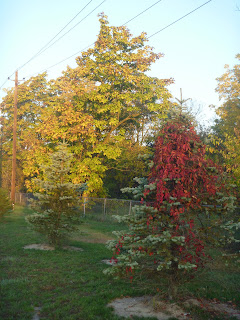
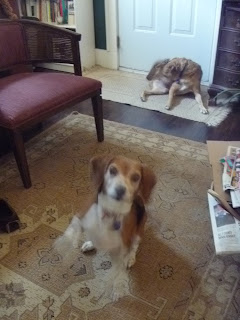
Trees, Vines, Dogs

Some pictures for your amusement.

1. Tree and vine on the morning commute

2. Cute dog and, um ...

08 September 2011

Another Classy Confluence

Imagine my surprise, when reading an obit on the Goshen News website, to suddenly hear that George Strait is "here for a good time." The song sounds nice. Not sure an audio ad for it in the obits was the best choice.

And here's the screenshot partial proof.


What ad do you get?


29 May 2011

Brent's Kickin' Mango Vinaigrette

  • 1 medium-large mango, not quite ripe (if your fingers get sticky when handling it, it's more ripe than the one I used, but that would probably be delicious)
  • extra virgin olive oil, red wine vinegar, white vinegar, lime juice, sugar, chile powder, and garam masala to taste.
Put everything in a blender and pulse until emulsified.

(Yes, I wish I'd taken better notes while I was concocting this.)

28 April 2011

Offer

A few questions about the "rock-like stick" I was offered yesterday morning:
  • Define "rock-like." Is this stick created from minerals? Synthetic mineral-like substances?
  • Is this stick useful for, say, slaying Philistine giants? What about other instances where I would typically use a rock?
  • It sounds like you expect me to pay for this stick--rocks are free. What advantages does the stick have over the rock in these instances?
  • What additional things could I do with a rock-like stick that I cannot do with an ordinary stick (which is also free)?
  • Does the simplicity of having a single rock-like stick over needing both a stick and rock justify the cost of the newer device?
  • Now that I think about it, wouldn't a truly rock-like stick be neither stick nor rock? Am I not signing up for the worst of both worlds?
I love spam.

19 February 2011

Correlation/Causation

The spouse and I have, over the course of the last couple of years, noticed a disturbing correlation between aggressive driving (speeding up and whipping in to traffic in construction zones, passing then turning left, turning right at no turn on red intersections, weaving from one lane to another) and "In God We Trust" license plates.

Does being an aggressive driver lead one to obtain an "In God We Trust" plate as something of a ward against one's own aggressive driving? Or does professing trust in God lead one to think one's actions on the road will be rendered inert by the deity? Or is there some root cause that leads both to aggressive driving and obtaining an "In God We Trust" plate?

Or maybe I just notice the aggressive driving more because of the presence of the plate? Nah, couldn't be.

29 December 2010

Posterity

"Next time we go to India, I'm going to ..."

"Next time we go to India, we should ..."

Both these sentences were uttered tonight by someone's (my) spouse. I'm just noting this here for posterity.

07 July 2010

Essen v. Fressen

Today as I passed Hawthorne Elementary School I noticed the sign: "Sum[mer] Feeding: 11:30 - 1:30."

Apparently poor people are cattle.

Visual proof to come if the camera returns in time.

Related: http://www.etruth.com/Know/News/Story.aspx?id=517315

06 June 2010

To the driver (part 2) ...

... of the hearse with Elkhart license plate 736UN, beside whom I parked tonight in the Martin's parking lot, and who waggishly propped in the window of said hearse a mask of an obviously older woman wearing sunglasses: well-played.

07 May 2010

To the driver ...

... of the maroon truck with "In God We Trust" plates whom I followed from Lusher Avenue to the Prairie Street Kroger:

Since your truck appeared to be fairly new, I thought perhaps you hadn't fully familiarized yourself with it's communications equipment. On the left side of the steering column you will likely find a lever. Pushing that down will tell other people that you plan to make a left turn, like when you turned onto Prairie from Lusher. Similarly, you can push the lever up and those around you will know that you plan to make a right turn, like when you turned into Kroger from Prairie.

You'll note that neither of these actions does anything for you personally, except perhaps to increase the goodwill of others toward you.

You're welcome.